Shopping and Cooking on GLP-1: When the Household Still Eats

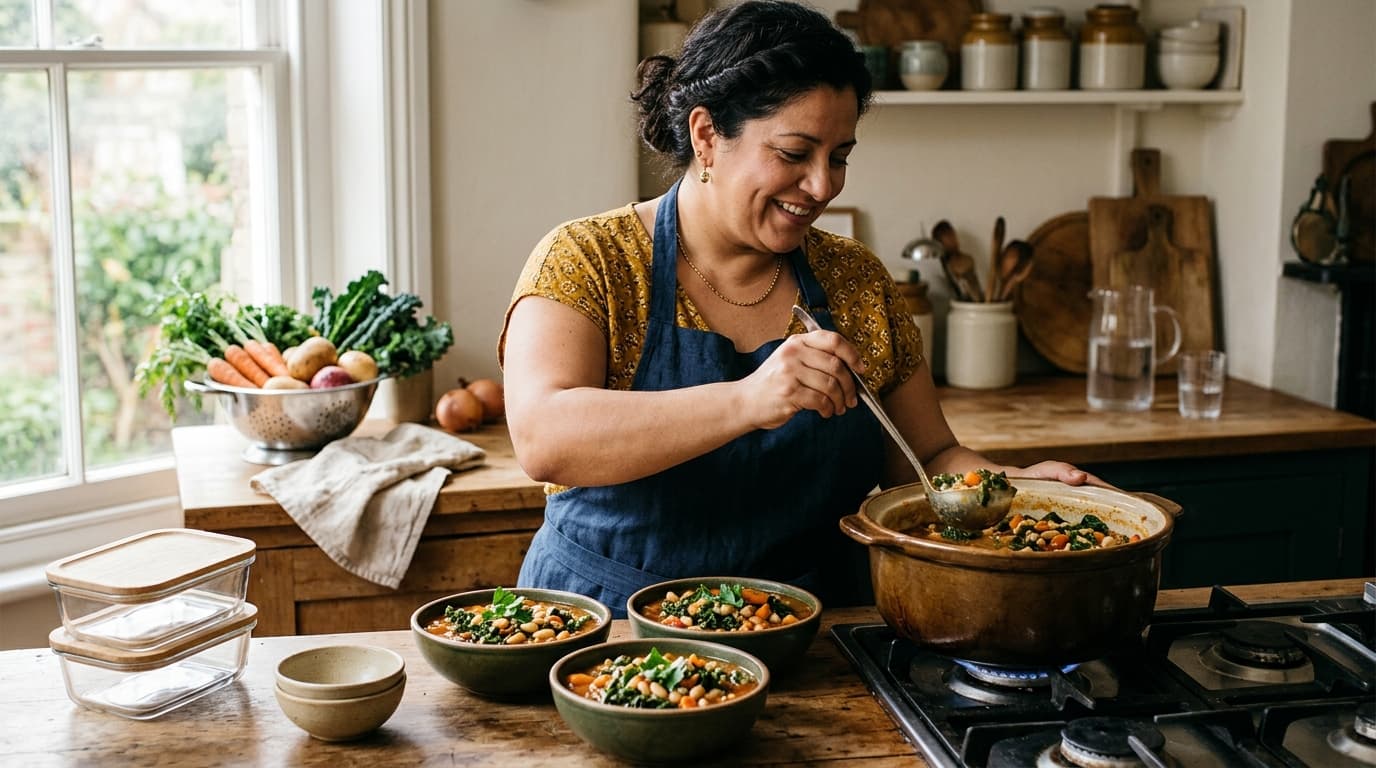
You eat a fraction of what you used to; nobody you live with has changed. In a US household panel, grocery spending fell 5.3% within six months. In a 505-person US survey, a quarter agreed they waste more food. The fix is one meal served two sizes - never a separate plate, never a cleared one.
Your appetite changed. The people you live with did not. The shopping, the pot size and the leftovers all have to be renegotiated, and US spending data says the shopping really does shift. Cook one meal, serve yourself less of it, and stay at the table after your plate is empty.
A practical article about shopping and cooking, not medical advice. For anything about your medication, appetite or nutrition, ask your prescriber or pharmacist.
By Ada Serra. Editor: Sezen Soykut.
Key takeaways
- In a representative US household panel, households with at least one GLP-1 user cut grocery spending by 5.3% in six months. That is documented, not fussiness.
- Throwing more away early on is commonly reported. Nobody has studied a household where one member's intake dropped.
- Cook the one meal everyone eats and serve yourself less of it. A separate plate is what makes the table awkward.
- Never solve the leftovers by eating them. Clearing the plate is a trade-off, not a virtue.
- Staying at the table after you finish is the part worth protecting.
The shopping is the first thing that gives
The trolley stops making sense before anything else does. Pack sizes are wrong, the weekly rhythm is wrong, and the instinct for how much we need was calibrated by a different appetite.
This is measurable. In a representative US household panel, households with at least one GLP-1 user reduced grocery spending by 5.3% within six months of adoption, with the biggest reductions in calorie-dense, processed categories — spending on savory snacks fell 10.1% — and a few categories rising instead, yogurt most of all [1]. The shift persisted through the first year of medication use, with some attenuation after six months [1].
Read it narrowly. That study measured money spent on food in US households, from transaction records — not what anyone ate, who ate it, or how much went in the bin. What it buys you is permission: the shopping really does change, at the level of the whole household's bill, and reorganising it is normal rather than you being difficult.
The practical half needs no study. Buy smaller amounts more often of what spoils, the same as before of what keeps, and write the list down, because the old sense of that's about right no longer calibrates.
The bin, and what it is not
Nobody warns you that for a while you throw more away. Among 505 US consumers recruited online who self-reported using a GLP-1 agonist, 25% agreed with the statement "Since beginning this medication I have found I waste more of the food that I purchase," while 61% disagreed [2].
Two caveats. That is a convenience sample, answering at one point in time about their own purchases — not a measurement of anyone's bin, nor a prevalence figure. The comparison also runs across people rather than over time: respondents on the medication longer were significantly less likely to agree, those reporting nausea significantly more likely [2]. The authors call their own explanation a conjecture, and so do we. No study has looked at waste in a household where one member's intake dropped; that research does not exist yet.
Do not fix it by eating. A diary study of 515 Swiss households found that people with stronger plate-clearing habits wasted less food — and the authors flag the cost, "a relevant trade-off between reducing food waste on plates and increased overeating" [3]. Finishing food you do not want is not thrift. It moves the waste.
The repairs are ordinary kitchen competence. Freeze in single portions rather than one block, dated. Cook once and serve it differently across the week. Put leftovers away before you sit down. Let people serve themselves from the middle of the table instead of plating for everyone — then nobody is watching how much you took.
Why the shared table pulls harder than the kitchen
A 2017 commentary in the Journal of Eating Disorders makes the point most relevant here: explanations of why people eat more in groups tend to ignore "the increased per capita provision of food when people eat together" [4]. It is a commentary offering an alternative explanation, not new data — but it reframes what you have been taking personally. More food gets put out: a serving-volume problem, not a character problem.
The research on who you eat with is narrower than usually quoted. A 2019 meta-analysis of 42 studies in The American Journal of Clinical Nutrition found "strong evidence that people select and eat more when eating with friends," and "no evidence" for the same effect with strangers or acquaintances [5]. Family was not a tested category. The only family-specific evidence is a 1994 food-diary study of 515 adults: meals with spouse and family were larger and eaten faster, meals with friends larger and longer [6]. None of this literature involves anyone on these medications.
So eat the same meal as everyone else, in a smaller amount. A separate plate marks you out every night; the same dish, less of it, does not. The restaurant version is in eating out on GLP-1, and the new quiet in your own kitchen is food noise.
The part worth keeping
Dunbar's 2017 survey of 2,000 UK adults suggests people who eat socially more often "feel happier and are more satisfied with life" [7]. It is a cross-sectional poll and "suggests" is the author's own word — but the direction is worth something when your plate is a third of what it was.
Finishing first is not a signal to leave. Stay for the part that was never about the food. To see which routines are likeliest to hold, the habit readiness assessment is a short self-check; habits that outlast the prescription covers the longer arc.
Gila's pilot is free and iPhone-only for now: sign up and the TestFlight invite comes by email. For one practical piece like this a week, subscribe to the newsletter.
Sources
- Hristakeva S, Liaukonytė J, Feler L. The No-Hunger Games: How GLP-1 Medication Adoption Is Changing Consumer Food Demand. Journal of Marketing Research, 2026;63(3):427–444. doi:10.1177/00222437251412834
- Mansouri J, Roe BE. Changes in Food Waste among a Sample of U.S. Consumers after Beginning Anti-Obesity Medication. Nutrients, 2024;16(19):3274. doi:10.3390/nu16193274
- Liechti C, Mack G, O'Sullivan K, Stöckli S, Beretta C, Tiefenbeck V, Ammann J. Predictors of food waste quantities and composition: A nationwide diary study of Swiss households. Waste Management, 2026. doi:10.1016/j.wasman.2026.115717
- Herman CP. The social facilitation of eating or the facilitation of social eating? Journal of Eating Disorders, 2017;5:16. doi:10.1186/s40337-017-0146-2
- Ruddock HK, Brunstrom JM, Vartanian LR, Higgs S. A systematic review and meta-analysis of the social facilitation of eating. The American Journal of Clinical Nutrition, 2019;110(4):842–861. doi:10.1093/ajcn/nqz155
- de Castro JM. Family and friends produce greater social facilitation of food intake than other companions. Physiology & Behavior, 1994;56(3):445–455. doi:10.1016/0031-9384(94)90286-0
- Dunbar RIM. Breaking Bread: the Functions of Social Eating. Adaptive Human Behavior and Physiology, 2017;3:198–211. doi:10.1007/s40750-017-0061-4
Related Articles

GLP-1 and Sleep: What the Labels and the Studies Actually Say
Insomnia is listed as a common side effect on one GLP-1 label — liraglutide, mainly in the first three months — and on none of the weekly medicines. This piece reports what the product information and two small uncontrolled studies show, why none of it proves cause, and the sleep routine you can control and log.
Read more →
Hunger Between Doses: What Is Known, and What Nobody Has Measured
The half-lives are label-established; the day-by-day story is not. We ran 18 literature searches and found no study measuring hunger, food noise or energy across the days between weekly doses. What the labels do and do not say, why people differ, and how to keep a log that shows your own week.
Read more →
Traveling with GLP-1: Pens, Flights and Your Routine
✈️ **Travel Smart, Stay On Track!** Planning a trip with your GLP-1? This essential guide helps you confidently navigate everything from understanding your pen's storage limits and breezing through airport security, to strategically packing small habits. We love how it turns coming home into a perfect opportunity to intentionally rebuild your routine, keeping your progress strong!
Read more →Ready to start your GLP-1 journey?
Gila helps you build lasting habits, understand your body, and stay on track. Join the pilot for free.
Join the Pilot