Food Noise on GLP-1s: What It Is and How to Navigate It

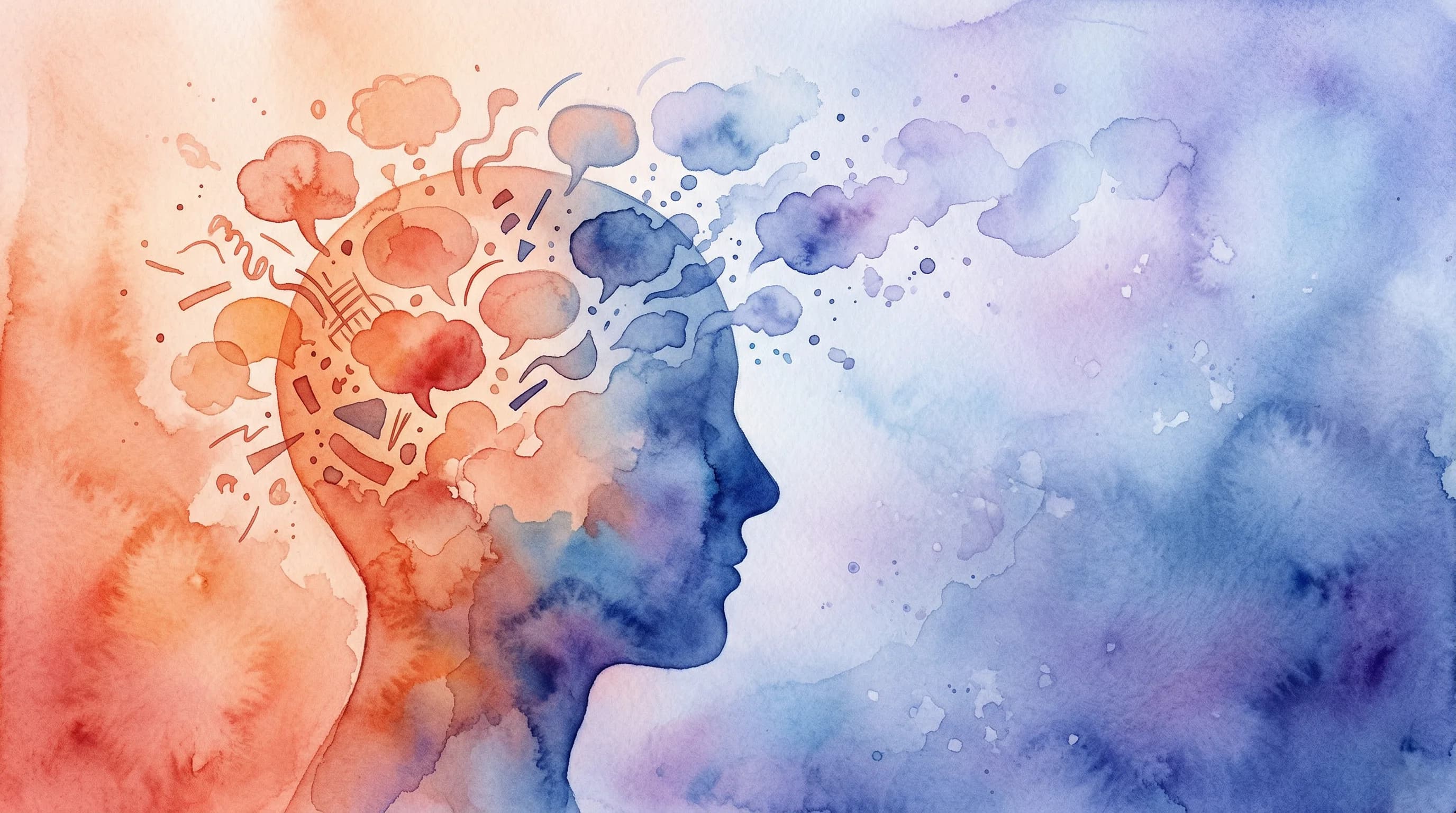
Food noise is the constant mental chatter about eating. Learn why GLP-1 medications quiet it, what happens when it returns, and how to build lasting change.
What Is Food Noise?
Imagine a radio that never turns off. It's not blasting — it's not even playing a song you chose. It's just there, humming in the background, cycling through the same few stations: What should I eat for lunch? I shouldn't have eaten that this morning. There's leftover pizza in the fridge. Should I skip dinner to make up for it? What if I'm hungry later?
That's food noise.
Food noise is the persistent, intrusive mental preoccupation with food that goes far beyond physical hunger. It's not your stomach growling. It's not craving a specific nutrient your body needs. It's a cognitive pattern — a loop of food-related thoughts that runs in the background of your day, often without your permission or awareness.
For some people, food noise is a whisper. For others, it's a roar. And for millions of people, it's simply been the default setting for so long that they didn't know there was another way to experience the world.
The term has gained significant recognition in both clinical circles and online communities in recent years, especially as GLP-1 medications have given people a frame of reference they never had before. When medication quiets the noise, many people realize for the first time just how loud it was — and that not everyone experiences it the same way.
Here's what's important to understand: food noise is not a character flaw. It's not a sign that you lack something. It's a neurobiological phenomenon influenced by hormones, neurotransmitters, stress responses, sleep patterns, and a lifetime of learned associations between food and comfort, reward, or safety. It's real, it's measurable, and it's far more common than most people think.
Understanding food noise matters because it reframes the conversation. When you recognize that persistent food thoughts are a cognitive pattern — not a moral one — you stop asking "What's wrong with me?" and start asking "What's happening in my body and brain right now?" That question changes everything.
Update, July 2026: Mayo Clinic researchers just found a biological reason some people experience food noise as near-constant snacking rather than big meals — a subgroup with faster stomach emptying and lower natural fullness hormones, traced to the gut lining itself, not the microbiome. Read the study, explained.
When the Noise Goes Quiet
If you've started a GLP-1 medication — semaglutide, tirzepatide, or one of the emerging options — there's a good chance you've experienced something that's hard to put into words. Within days or weeks of starting treatment, many people describe a profound shift in their relationship with food thoughts.
Not a diet. Not a restriction. A quiet.
Community members describe it in remarkably similar ways. One person shared that for the first time in their life, they could drive past a restaurant without an automatic mental negotiation about whether to stop. Another said they didn't realize how loud the noise was until it stopped — like living next to a highway for decades and only noticing the sound when you finally move somewhere quiet.
The reduction in food noise is one of the most frequently reported experiences among GLP-1 users, and research is beginning to catch up with what communities have been saying for years. These medications appear to affect not just appetite and satiety signals, but the higher-order cognitive preoccupation with food itself. GLP-1 receptor agonists work on areas of the brain involved in reward processing and impulse regulation — which may explain why the effect feels less like "eating less" and more like "thinking about food less."
For many people, the quiet brings immediate relief. Grocery shopping becomes simpler. Mealtimes feel less loaded. Mental bandwidth opens up for things that had been crowded out for years — hobbies, conversations, creative projects, rest.
But the quiet can also bring unexpected emotions.
Some people feel grief — a surprising mourning for the coping mechanism that food thoughts provided. If thinking about food was how you managed anxiety, loneliness, or boredom, its absence can feel disorienting. Others feel confusion: If I'm not thinking about food all day, what do I think about? Some describe a strange emptiness where the noise used to be.
All of these responses are valid. The quiet is not just a medical outcome — it's an emotional transition. And like any transition, it deserves attention and care, not just celebration. If food has been your primary way of processing emotions for years or decades, the sudden absence of that reflex leaves a gap. Filling that gap with awareness — rather than rushing to replace it with something else — is some of the most important work you can do on this journey.
When It Comes Back
Here is something that doesn't get talked about enough: for many people, food noise returns.
It might happen when you miss a dose. It might creep back during a period of high stress — a family crisis, a job change, a sleepless week. It can resurface during hormonal shifts. And for those who taper off medication or stop treatment entirely (which happens more often than you might expect), the return of food noise can feel like a wave crashing over a seawall you thought was permanent.
The experience of food noise returning after a period of quiet is uniquely destabilizing. When you've tasted the quiet, the noise feels louder than it ever did before — not because it's objectively worse, but because now you have a comparison point. You know what it feels like to live without it.
So let's say this clearly: the return of food noise does not mean failure. It does not mean the medication "stopped working." It does not mean you're back to square one. It means you're human, living in a human body that responds to biology, environment, and circumstance.
The return of food noise is information. It's a signal — about your body, your stress levels, your medication, your sleep, your emotional state. And information is something you can work with.
What matters most in these moments is how you relate to the noise when it shows up again. If you meet it with self-blame, it amplifies. If you meet it with curiosity — Oh, you're back. I wonder what's going on — it becomes manageable. Not comfortable, necessarily. But manageable.
It can also help to talk with your healthcare provider about what you're experiencing. Changes in food noise can be a useful data point for adjusting dosage, timing, or approach. You don't have to navigate this alone, and you don't have to wait until things feel unmanageable to reach out.
Navigating the Quiet
When food noise decreases — whether through medication, behavioral shifts, or both — there's a window of opportunity. Not to "fix" yourself. Not to overhaul your life in a sprint. But to build patterns and awareness that will serve you regardless of what happens with your treatment.
Here are four approaches that GLP-1 community members and behavioral health practitioners consistently point to:
Noticing Without Reacting
When a food thought arises — and it will, even during the quiet periods — practice observing it rather than acting on it immediately. This isn't about ignoring cravings or pretending they don't exist. It's about creating a small space between the thought and your response.
A craving is data, not a command.
You might notice: I'm thinking about chocolate right now. Then, instead of immediately reaching for it or immediately judging yourself for wanting it, you pause. Am I physically hungry? Am I tired? Am I avoiding something? Sometimes the answer is "I just want chocolate, and that's fine." Sometimes it reveals something else entirely. Both outcomes are useful.
This mindfulness approach is especially powerful during the quiet period because you have more cognitive space to practice it. The noise isn't demanding all your attention, so you can actually hear the individual thoughts. Over time, this practice builds a kind of internal muscle memory. You get faster at recognizing when a thought is just a thought — and that recognition becomes a tool you carry with you, even when the noise returns.
Building Meal Routines
One of the hidden costs of food noise is decision fatigue. When your brain is constantly cycling through food options, every meal becomes a negotiation. Reducing that overhead through simple, flexible routines can be remarkably freeing.
This doesn't mean rigid meal plans or counting every calorie. It means having a general structure: a few go-to breakfasts, a lunch pattern that works for your schedule, a rough dinner framework. When the structure is in place, you spend less mental energy on the what and more on actually enjoying the meal.
The quiet period is an ideal time to establish these routines, because you're not fighting the noise while you build them. You're laying foundation in calm conditions — and that foundation holds up better when the weather changes.
Journaling
Not calorie tracking. Not food logging. Journaling.
The kind of journaling that connects what's happening in your body to what's happening in your life. The kind that asks: How did I feel before that meal? What was my energy like at 3pm? Did I eat because I was hungry or because the meeting stressed me out?
This narrative approach to tracking helps you see patterns over time — patterns that are invisible in the moment but obvious in retrospect. You might discover that your food noise spikes every Sunday evening, or that skipping lunch consistently leads to a difficult evening. These aren't moral failures. They're patterns, and patterns can be gently adjusted once you see them.
A journal also becomes a record of your own growth. On the hard days, you can look back and see how far you've come — not in pounds or metrics, but in self-understanding. It creates a conversation with yourself across time — one where the version of you from three months ago can offer comfort, context, or a gentle reminder of what you already know to be true.
Connecting With Others
The GLP-1 experience is deeply personal, but it doesn't have to be private. Sharing your experience with others who understand — whether in online communities, support groups, or with a trusted friend — does something that no solo practice can: it normalizes the journey.
When you hear someone else describe the exact emotional complexity you're feeling, the isolation dissolves. When you share your own experience, you often understand it better yourself. And when someone a few steps ahead of you says "that happened to me too, and here's what helped," it's more powerful than any clinical recommendation.
Community doesn't replace professional support. But it provides something professionals can't: the lived resonance of shared experience.
The quiet period is also an excellent time to build habits that will serve you long after your current prescription — small, sustainable patterns that become part of who you are, not just what you do while medicated.
When Food Noise Returns
If you're reading this section because the noise has come back — take a breath. You're okay.
The return of food noise after a quiet period can feel overwhelming precisely because of the contrast. But here is what's true, even when it doesn't feel true: the awareness you built during the quiet period doesn't disappear when the noise comes back.
Think about what you've gained during the quiet period. You learned to notice thoughts without reacting. That skill is still in you. You built meal routines that reduced decision fatigue. Those routines are still available. You connected patterns between your emotions and your eating. That knowledge is permanent. You may even have built new habits — ones strong enough to carry you through exactly this kind of moment.
The noise may be louder, but you are different now.
Community members who've navigated the return describe it with a consistency that's hard to ignore. One person explained that the noise came back, but this time they had tools — the pause, the awareness, the routines — that they didn't have before. Another said they recognized the noise faster, and that early recognition made all the difference. Instead of weeks of confusion, it was hours. Instead of spiraling, it was a moment of "Oh, I know what this is."
The goal isn't silence forever. The goal is understanding what the noise is telling you — and trusting that you can respond to it with care.
Food noise is not a verdict. It's not a permanent condition or a personal failing. It's a signal from a complex system — your body, your brain, your environment, your history — and like any signal, it carries information if you're willing to listen.
Some days the noise will be quiet. Some days it won't. What changes over time isn't necessarily the volume — it's your relationship to it. You move from being at the mercy of every food thought to being able to hold them lightly, examine them with curiosity, and choose your response.
That shift — from reactive to responsive — is not something medication gives you. Medication may have created the space for you to discover it, but the shift itself is yours. It belongs to you. And it stays with you, through the quiet periods and the loud ones alike.
If you're in a quiet period right now, use it well — not frantically, but intentionally. Build the routines. Practice the awareness. Connect with people who get it. These things compound over time, and they become the foundation you stand on when the ground shifts.
If the noise has returned, be gentle with yourself. You know more now than you did before. You understand what food noise is, where it comes from, and that it doesn't define you. That understanding is not a small thing — it's the beginning of a fundamentally different relationship with your own mind.
You're not starting over. You're continuing. And there's an entire community walking this path alongside you.
Key Takeaways
- Food noise is neurochemistry, not a character flaw — GLP-1s quiet it by acting on reward centers in the brain
- The quiet the medication creates is a starting line, not a destination — build habits in that space
- Journal the moments when food noise is absent to build evidence for your new identity
- If noise returns during dose changes, the habits and awareness you built remain yours
Get insights on food noise, habits, and identity delivered weekly. Subscribe to the Gila newsletter.
Build the identity that outlasts the quiet. Join the Gila pilot — founding members get their first year free.
Related Articles

Traveling with GLP-1: Pens, Flights and Your Routine
A trip changes where your GLP-1 pen lives and what your day looks like. This piece sets out what each US label says about keeping pens cold, how TSA, UK and CDC guidance handle medication in transit, why travel loosens routines, and how to rebuild yours in the first three days home.
Read more →
Eating Out on GLP-1: Restaurants and Social Meals
A smaller appetite meets big restaurant portions and a table of people who love you. This piece covers why eating with friends pulls harder, how to decide before you go, how to order down or share, and short lines for when someone offers just one more.
Read more →
GLP-1 Hydration: Why Drinking Enough Gets Harder
On GLP-1 treatment, fluids can slip two ways: a smaller appetite means less water from food, and nausea, vomiting or diarrhea take fluid out. This piece quotes what the US and EU labels say about dehydration, gives EFSA's general adult reference, and sets out simple if-then routines to keep drinking.
Read more →Ready to start your GLP-1 journey?
Gila helps you build lasting habits, understand your body, and stay on track. Join the pilot for free.
Join the Pilot