Eating Out on GLP-1: Restaurants and Social Meals

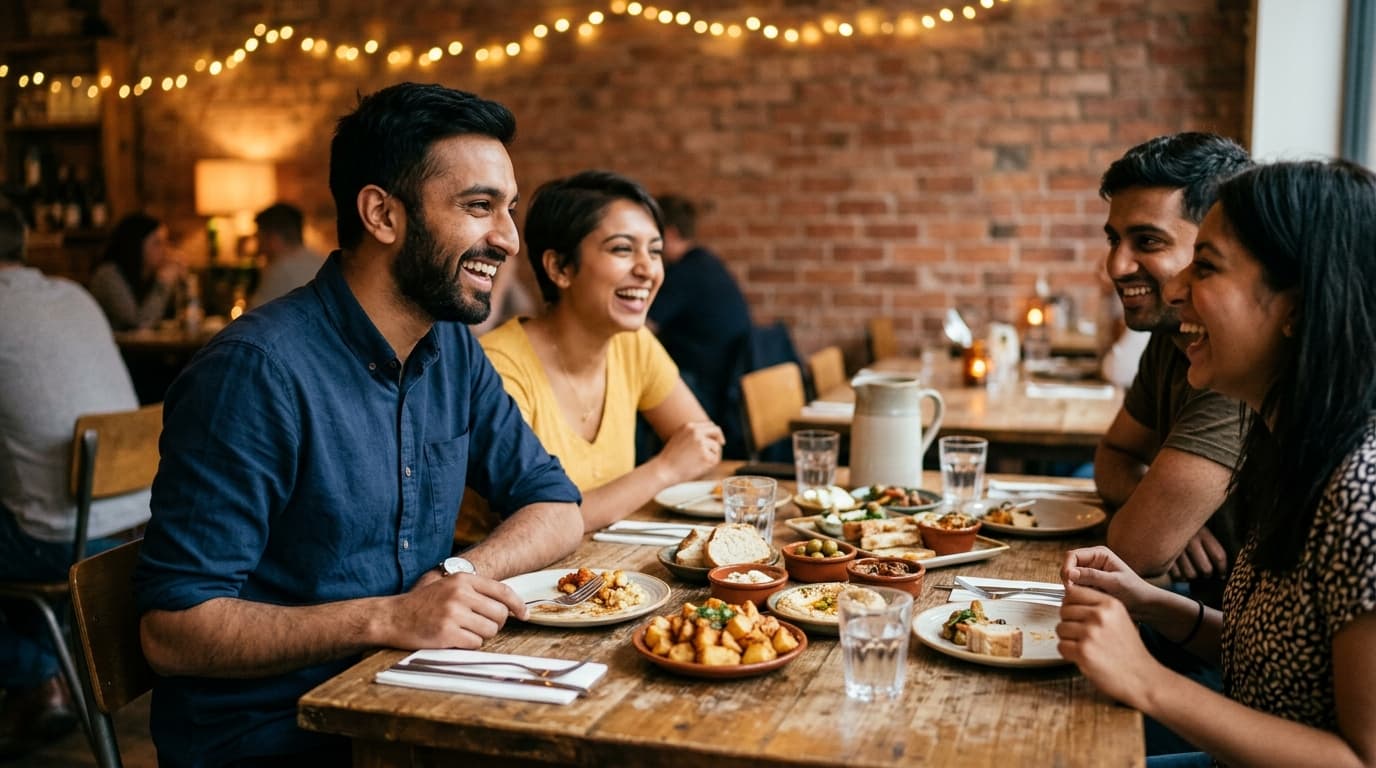
A smaller appetite meets big restaurant portions and a table of people who love you. This piece covers why eating with friends pulls harder, how to decide before you go, how to order down or share, and short lines for when someone offers just one more.
Eating out on a GLP-1 goes more smoothly when the decisions happen before you sit down. Pick the place, choose a smaller order (a starter, a side or a shared dish), plan one sentence for when someone pushes "just one more," and treat the leftovers box as normal. The goal is to stay at the table, not to clear the plate.
This is a behavioural article about social eating, not medical advice. For anything about your medication, ask your prescriber or pharmacist.
By Ada Serra, behaviour-lane writer and host of the Gila Podcast. Editor: Sezen Soykut.
Key takeaways
- Eating more around friends is a documented effect, not a personal failing. Research finds it with friends, not with strangers.
- The most useful moment to change a restaurant meal is before you arrive: where you go, what you order, what you will say.
- Smaller orders are ordinary: a starter as a main, a shared dish, half boxed to take home.
- A short, friendly sentence works better than an explanation.
- Staying at the table matters more than what is on your plate.
Why the table feels harder than the kitchen
At home you control the plate. At a restaurant or a family lunch, the portion arrives already decided and someone is watching whether you liked it.
There is a name for part of this. A 2019 meta-analysis in The American Journal of Clinical Nutrition describes how "people tend to eat more when eating with other people, compared with when they eat alone" — the social facilitation of eating [2]. The effect has a specific shape: the authors found "strong evidence that people select and eat more when eating with friends" compared with eating alone, and "no evidence" for the same effect with strangers or acquaintances [2]. Familiarity is what moves it.
So if the hardest meals are the ones with friends, that fits the research. It's how eating together works, not a flaw in you.
Decide before you go
Most of the useful decisions happen before the menu arrives. Goal researchers call this an implementation intention: an if-then plan made in advance. Across 94 tests, a meta-analysis by Gollwitzer and Sheeran found these plans had "a positive effect of medium-to-large magnitude (d = .65) on goal attainment," including "the shielding of ongoing goal pursuit from unwanted influences" [3]. That work is about goals in general, not food or medication. The mechanism still carries over well:
- If the bread basket arrives, then I'll take one piece and ask for it to go to the other end of the table.
- If the main courses look huge, then I'll order a starter as my meal.
- If someone says "you've barely eaten," then I'll say my line (see below) and ask them a question.
Where you can, have a say in the place. The US National Institute of Diabetes and Digestive and Kidney Diseases suggests you "avoid all-you-can-eat buffets" and "choose restaurants that offer some healthy food choices in controlled portions" [1]. A menu with small plates or starters gives you more options than one built on the mixed grill.
Ordering for a smaller appetite
Your appetite may have shrunk faster than restaurant portions do. That's fine. You have ordering options:
- Order down. The NIDDK suggests you "order one or two healthy appetizers or side dishes instead of a whole meal" [1]. Nobody at the table will notice.
- Share. "Share a meal with a friend or take half your meal home" [1]. Asking for a box at the start and setting half aside before you begin takes the question off the table.
- Go family-style. The same guidance suggests asking for dishes "served 'family style.' You can order three meals to serve five people, and everyone can taste a portion of each dish" [1]. For a big family table this often works well: everyone tastes everything, and nobody is watching one plate.
If you're working with a clinician or dietitian on what to put first on a small plate, bring that into the order. We've covered protein and muscle on GLP-1s separately.
Finishing the plate, and "just one more"
Many of us learned that a clean plate is polite. The NIDDK's advice is short: "Stop eating and drinking when you're full. Put down your fork and glass" [1]. The physical cue helps. A fork laid across the plate tells the waiter, and your aunt, that you're done, without anyone having to say it.
When someone offers "just one more" (a second helping, dessert, a bite of theirs), you don't owe them a medical history. Pick a line and reuse it:
- "It was lovely. I'm properly full."
- "I'll take some home for tomorrow."
- "I'll have a taste of yours."
- "Save me a piece to take home."
Then ask the person who's pushing about something they care about. Most of the time they're offering care, not testing you. Accept the care; leave the food.
If feeling full tips into feeling unwell, that's worth noting. The prescribing information for semaglutide (Wegovy) and tirzepatide (Zepbound) lists nausea, vomiting, abdominal pain and dyspepsia among the most common side effects [4][5]. If a big meal regularly leaves you like that, raise it with your prescriber rather than pushing through.
A note on drinks
Social meals often come with a drink offer. That's a question for your prescriber, not for a restaurant table. We've gathered what we could verify in Alcohol and GLP-1 medications. Water or something without alcohol in your glass also answers "can I get you another?" before anyone asks.
A routine for your next meal out
- The day before: look at the menu online. Choose two options that fit a smaller appetite.
- On the way: write your three if-then plans in one line on your phone.
- At the table: order down, share, or ask for a box early.
- During: fork down when you're full. Use your sentence. Stay for the conversation.
- After: one line on what worked. If you use Gila, log the meal with a short note, so you can look back over a few weeks.
A quiet appetite meeting a loud menu can feel strange. We wrote about what food noise is and how to navigate it.
Keep reading
- GLP-1 Hydration: Why Drinking Enough Gets Harder
- Traveling with GLP-1: Pens, Flights and Your Routine
FAQ
Do I need to plan my dose around a dinner out? The Wegovy and Zepbound labels say each weekly injection can be given "at any time of day, with or without meals" [4][5]. That line is from those two labels only; your own medicine's leaflet is the one that applies. Don't change your schedule for an event without asking your prescriber or pharmacist first.
Is it rude to order just a starter? No. It's a normal order, and the NIDDK suggests it as a portion strategy [1]. If anyone asks, "I'm not very hungry tonight" is true and enough.
What if my family takes it personally? Keep the plate small and your presence big. Taste the dish they're proud of, ask for the recipe, take some home. You're refusing the portion, not the person.
Your appetite may be quieter than it used to be. Deciding ahead, saying one short sentence and staying at the table are how you keep the dinners you love.
Gila's pilot is free and iPhone-only for now: sign up and the TestFlight invite comes by email. For one practical piece like this a week, subscribe to the newsletter.
Sources
- National Institute of Diabetes and Digestive and Kidney Diseases (NIH). Food Portions: Choosing Just Enough for You. https://www.niddk.nih.gov/health-information/weight-management/just-enough-food-portions
- Ruddock HK, Brunstrom JM, Vartanian LR, Higgs S. A systematic review and meta-analysis of the social facilitation of eating. The American Journal of Clinical Nutrition, 2019;110(4). doi:10.1093/ajcn/nqz155. https://pubmed.ncbi.nlm.nih.gov/31435639/
- Gollwitzer PM, Sheeran P. Implementation intentions and goal achievement: A meta-analysis of effects and processes. Advances in Experimental Social Psychology, 2006;38:69–119. https://doi.org/10.1016/S0065-2601(06)38002-1
- FDA / Novo Nordisk. WEGOVY (semaglutide) injection, full prescribing information (rev. 07/2023). https://www.accessdata.fda.gov/drugsatfda_docs/label/2023/215256s007lbl.pdf
- FDA / Eli Lilly. ZEPBOUND (tirzepatide) injection, full prescribing information (rev. 01/2026). https://www.accessdata.fda.gov/drugsatfda_docs/label/2026/217806s002lbl.pdf
Related Articles
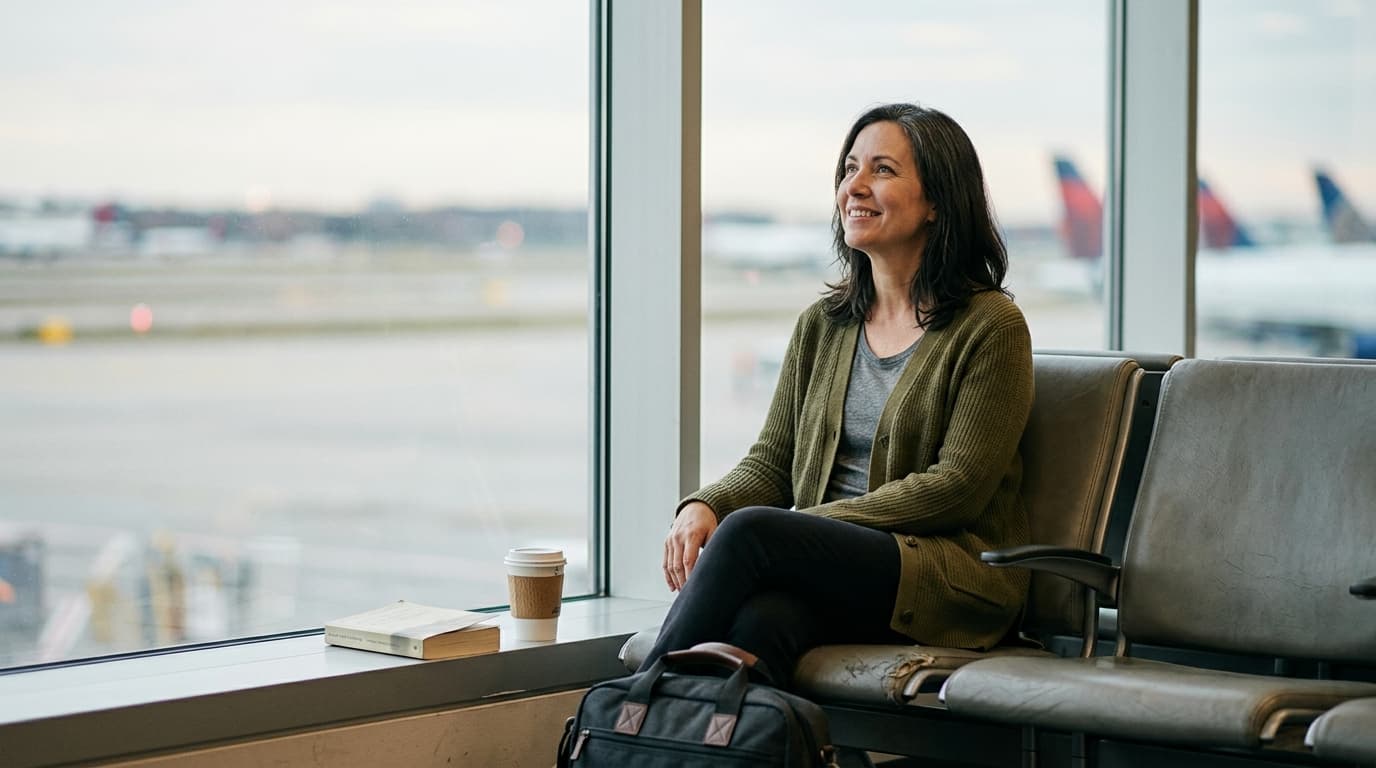
Traveling with GLP-1: Pens, Flights and Your Routine
A trip changes where your GLP-1 pen lives and what your day looks like. This piece sets out what each US label says about keeping pens cold, how TSA, UK and CDC guidance handle medication in transit, why travel loosens routines, and how to rebuild yours in the first three days home.
Read more →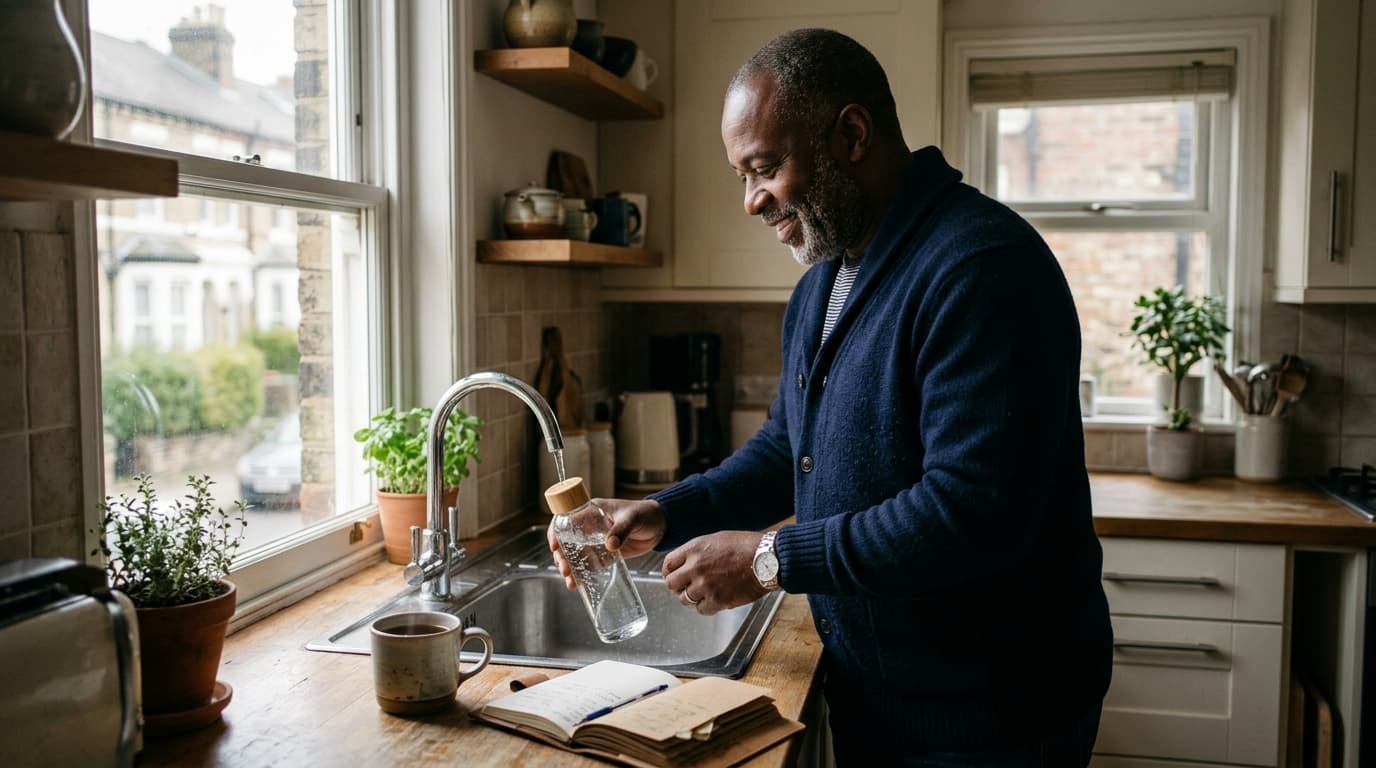
GLP-1 Hydration: Why Drinking Enough Gets Harder
On GLP-1 treatment, fluids can slip two ways: a smaller appetite means less water from food, and nausea, vomiting or diarrhea take fluid out. This piece quotes what the US and EU labels say about dehydration, gives EFSA's general adult reference, and sets out simple if-then routines to keep drinking.
Read more →
Shotsy vs GlucoPal: How These Two GLP-1 Trackers Compare in 2026
Shotsy and GlucoPal are both free-to-download GLP-1 dose trackers rated 4.8 stars. Shotsy runs on iPhone and Android in 17 languages; GlucoPal is iPhone-only but adds AI meal-photo scanning and a published Pro price. The detail most comparisons miss: Shotsy's Android build requires Google Sign-In.
Read more →Ready to start your GLP-1 journey?
Gila helps you build lasting habits, understand your body, and stay on track. Join the pilot for free.
Join the Pilot