Traveling with GLP-1: Pens, Flights and Your Routine

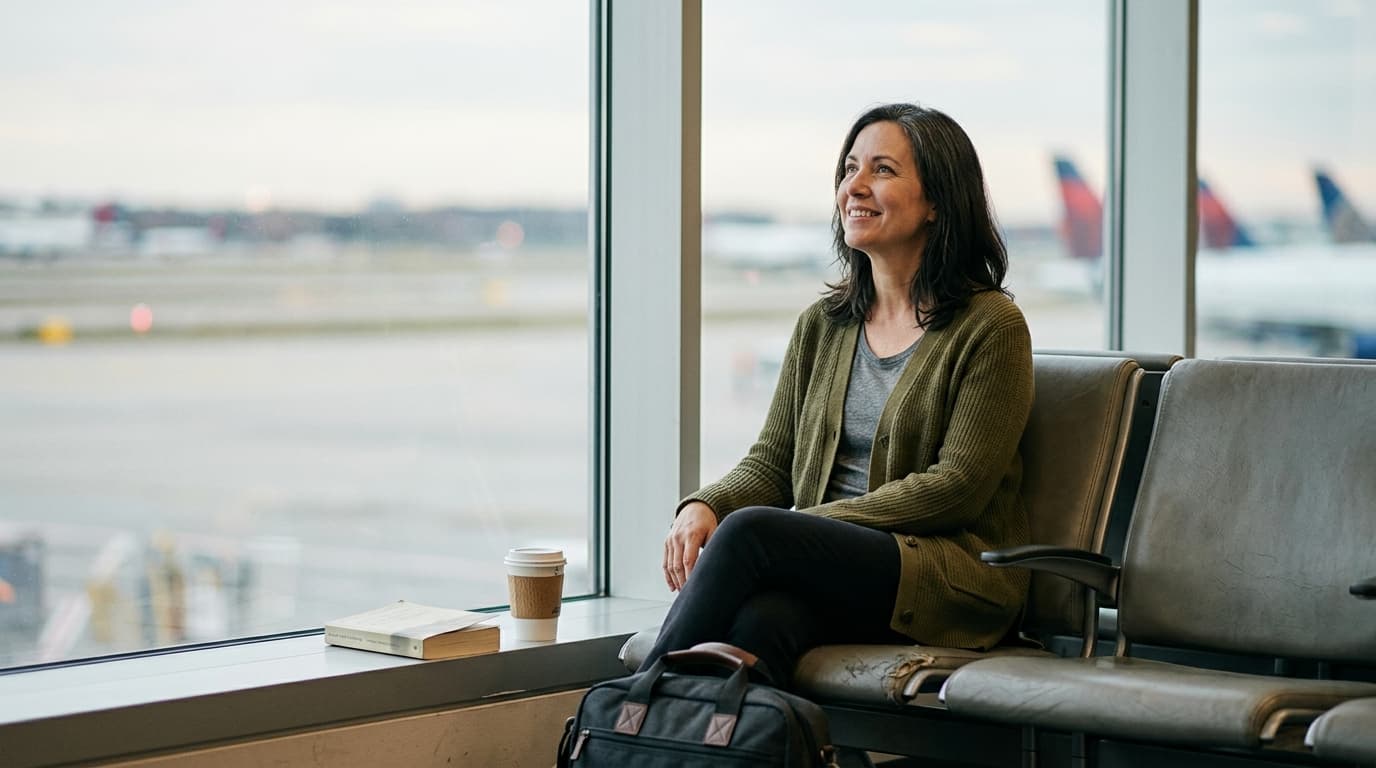
A trip changes where your GLP-1 pen lives and what your day looks like. This piece sets out what each US label says about keeping pens cold, how TSA, UK and CDC guidance handle medication in transit, why travel loosens routines, and how to rebuild yours in the first three days home.
A trip changes two things: where your pen lives and what your day looks like. The pen part is label-reading. Each product has its own fridge-free window, and airport security treats injectable medicine as a declared item. The routine part is behavioral: pack small habits and plan your first three days home.
This is a behavioral article about habits on GLP-1 treatment. It is not medical advice. For anything about your dose, timing or storage, ask your prescriber or pharmacist.
By Ada Serra, behavior writer and host of the Gila Podcast. Edited by Sezen Soykut.
Key takeaways
- There is no single "how long can my pen stay out" answer. The US labels give Wegovy 28 days, Ozempic 56 days after first use, and Zepbound and Mounjaro 21 days.
- Carry medication in hand luggage, in its original packaging, and declare it at security.
- None of the official sources we checked gives a time-zone dosing formula; ask your prescriber before you fly.
- Travel breaks the cues a routine runs on, which also makes coming home a good moment to rebuild it.
Keeping the pen cold: read your own label
Every label below agrees on the basics: refrigerate at 2°C to 8°C (36°F to 46°F) and never freeze. Where they differ is how long a pen can be kept out of the fridge.
The US prescribing labels:
- Wegovy: before the cap comes off, the pen "can be kept from 8°C to 30°C (46°F to 86°F) up to 28 days." Keep it in the original carton, away from light [1].
- Ozempic: after first use, the pen "can be stored for 56 days at controlled room temperature (59°F to 86°F; 15°C to 30°C) or in a refrigerator." Keep the cap on, and protect it "from excessive heat and sunlight" [2].
- Zepbound: unrefrigerated at no more than 30°C (86°F) "for up to 21 days." If it has been kept at room temperature, "it should not be returned to the refrigerator" [3].
- Mounjaro: unrefrigerated at no more than 30°C (86°F) "for up to 21 days," in the original carton [4].
Labels also vary by country and pen size: Spain's leaflet for Ozempic 1 mg gives 6 or 8 weeks after first use, depending on the pen [5]. The number in your pack is the one that counts. If a hot day or a long transfer leaves you unsure, ask a pharmacist rather than guessing.
Airport security: declare it, bin it separately
TSA has no page specifically for GLP-1 pens; the nearest match is its guidance for injectable medications like insulin pens. It allows "larger amounts of medically necessary liquids, gels, and aerosols in reasonable quantities for your trip," but "you must declare them to security officers at the checkpoint" [6]. For insulin, it asks you to tell officers and "place them in a bin separately for x-ray screening" [7]. Unused syringes "are allowed when accompanied by injectable medication" [8]. And "the final decision rests with the TSA officer" [6].
UK travel-health guidance says to carry medication "in its original pharmacy packaging, along with a copy of their prescription and letter from the prescriber," in hand luggage "with some extra in the hold luggage" [9]. The CDC is stricter: "All medications should be carried in hand luggage rather than in checked baggage," with enough for the trip "plus extra in case of unexpected delays" [10]. For longer stays, the NHS "accepts responsibility for supplying sufficient ongoing medication for temporary periods abroad of up to three months" [9].
Time zones and the dose you might miss
No official source we found offers a rule here. The CDC's advice is to "discuss when to take medications if travel involves changes in time zones" [10]. Ask before you go.
Each product's label also has its own missed-dose instructions, with different time windows [1][2][3]. Find that section in your leaflet before the trip, and if a delay throws your dose day, call your pharmacist or prescriber rather than working it out at the gate.
Why a trip knocks a routine loose
A routine runs on cues: the kitchen, the walk route, breakfast at the same time. Psychologists who study habits have shown that "when usual contexts for performance change, habits cannot be cued by recurring stimuli, and performance should be disrupted" [11]. That study followed students changing universities, not travelers, but the pattern is familiar.
The hopeful side: the same study found that, in some cases, the disruption "also placed behavior under intentional control" [11]. Researchers call this the Habit Discontinuity Hypothesis: the idea that behavior-change efforts are more effective at "moments of change" than under stable conditions [12]. The trip loosens your routine; coming home is the chance to rebuild it on purpose.
Eating and moving on the road
Pack the smallest version of your habits, not the full routine.
- Meals: protect one steady point, such as breakfast at roughly the same time. Let the rest of the day be a holiday.
- Water: carry a refillable bottle and fill it at every gate and every hotel.
- Movement: walk the first evening, wherever you are. A loop of the block counts; the point is the cue, not the distance.
- One note a day: a line on appetite and energy. It takes seconds and pays off at home.
A restaurant meal that leaves you fuller than expected is information, not failure. Next time, order smaller or share.
A travel checklist
Before you go
- Photograph your leaflet's storage and missed-dose sections.
- Ask your prescriber about time zones, and for a letter.
- Original packaging, hand luggage, enough for the trip plus a margin.
At the airport
- Declare medication and supplies; use a separate bin.
The first three days home
- Day one: restart your anchor habit, same time, same place.
- Day two: add the walk back.
- Day three: reread your trip notes and keep one change.
For the longer view, see how habits can outlast the prescription, why GLP-1s are tools rather than solutions, and what maintenance actually looks like.
Keep reading
FAQ
How long can my GLP-1 pen stay out of the fridge? It depends on product, pen and country. The US labels say 28 days for Wegovy, 56 days after first use for Ozempic, and 21 days for Zepbound and Mounjaro [1][2][3][4]. Check your own leaflet.
Can I take my pen through airport security? In the US, TSA guidance allows medically necessary liquids above the usual limit if you declare them at the checkpoint [6]; the officer decides.
Should I pack my pen in checked luggage? The CDC says all medication should travel in hand luggage [10]. UK guidance suggests hand luggage with some extra in the hold [9].
Gila keeps habits, meals and mood in one place, so the week after a trip is visible without relying on memory.
The Gila pilot is free and currently on iPhone: sign up here. Our weekly newsletter is here.
Sources
- US FDA, WEGOVY (semaglutide) injection, prescribing information, rev. 10/2025, §16 and §2.4. https://www.accessdata.fda.gov/drugsatfda_docs/label/2025/215256s026lbl.pdf
- US FDA, OZEMPIC (semaglutide) injection, prescribing information, rev. 9/2023, §16 and §2.2. https://www.accessdata.fda.gov/drugsatfda_docs/label/2023/209637s020s021lbl.pdf
- US FDA, ZEPBOUND (tirzepatide) injection, prescribing information, rev. 12/2024, §16.2 and §2.3. https://www.accessdata.fda.gov/drugsatfda_docs/label/2024/217806s013lbl.pdf
- US FDA, MOUNJARO (tirzepatide) injection, prescribing information, rev. 11/2024, §16.2. https://www.accessdata.fda.gov/drugsatfda_docs/label/2024/215866s010s015s022lbl.pdf
- AEMPS CIMA, Prospecto: OZEMPIC 1 mg solución inyectable en pluma precargada. https://cima.aemps.es/cima/dochtml/p/1171251005/P_1171251005.html
- TSA, "Liquid Medications." https://www.tsa.gov/travel/security-screening/whatcanibring/items/liquid-medications
- TSA, "Insulin." https://www.tsa.gov/travel/security-screening/whatcanibring/items/insulin
- TSA, "Unused Syringes." https://www.tsa.gov/travel/security-screening/whatcanibring/items/unused-syringes
- NaTHNaC TravelHealthPro, "Medicines and travel." https://travelhealthpro.org.uk/factsheets/medicines-and-travel
- CDC Yellow Book, "Travelers with Chronic Illnesses." https://www.cdc.gov/yellow-book/hcp/travelers-with-additional-considerations/travelers-with-chronic-illnesses.html
- Wood W, Tam L, Guerrero Witt M. "Changing Circumstances, Disrupting Habits." J Pers Soc Psychol 2005;88(6):918–933. https://dornsife.usc.edu/wendy-wood/wp-content/uploads/sites/183/2023/10/Wood.Tam_.GuerreroWitt.2005_Changing_circumstances_disrupting_habits.pdf
- Verplanken B, Roy D, Whitmarsh L. "Cracks in the Wall: Habit Discontinuities as Vehicles for Behaviour Change" (2018). https://express.converia.de/custom/media/ESRI_2021/Verplanken__Roy____Whitmarsh__2018_.pdf
Related Articles

Eating Out on GLP-1: Restaurants and Social Meals
A smaller appetite meets big restaurant portions and a table of people who love you. This piece covers why eating with friends pulls harder, how to decide before you go, how to order down or share, and short lines for when someone offers just one more.
Read more →
GLP-1 Hydration: Why Drinking Enough Gets Harder
On GLP-1 treatment, fluids can slip two ways: a smaller appetite means less water from food, and nausea, vomiting or diarrhea take fluid out. This piece quotes what the US and EU labels say about dehydration, gives EFSA's general adult reference, and sets out simple if-then routines to keep drinking.
Read more →
Shotsy vs GlucoPal: How These Two GLP-1 Trackers Compare in 2026
Shotsy and GlucoPal are both free-to-download GLP-1 dose trackers rated 4.8 stars. Shotsy runs on iPhone and Android in 17 languages; GlucoPal is iPhone-only but adds AI meal-photo scanning and a published Pro price. The detail most comparisons miss: Shotsy's Android build requires Google Sign-In.
Read more →Ready to start your GLP-1 journey?
Gila helps you build lasting habits, understand your body, and stay on track. Join the pilot for free.
Join the Pilot