FDA 503B Comment Deadline Is June 29 — What Compounded GLP-1 Users Should Do Now

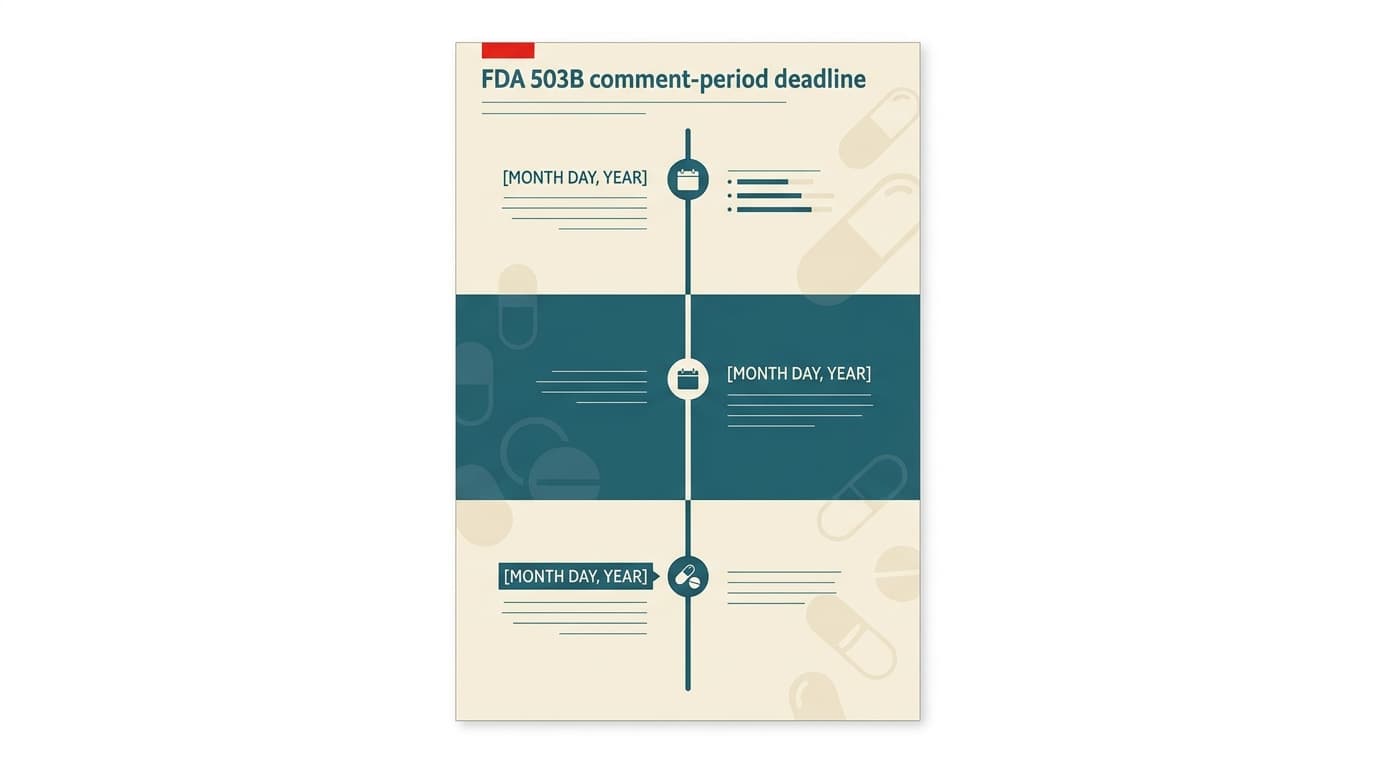
The FDA proposes to exclude semaglutide, tirzepatide, and liraglutide from the 503B Bulks List. The public comment period closes June 29, 2026. If finalized, most $200-400/month telehealth compounded GLP-1 paths close. Here's what changes, what doesn't, and what to do this month.
If you're on a compounded GLP-1 from a telehealth platform — semaglutide, tirzepatide, or liraglutide — you have until June 29, 2026 to weigh in on whether the FDA can keep those drugs available through large-scale 503B outsourcing facilities. After that, the agency reviews comments and makes a final determination.
The April 30 proposal didn't make headlines outside pharmacy-policy circles, but it's the biggest single regulatory change to compounded weight-loss medications since the 2024 shortage resolutions. We pulled the actual FDA press release and Federal Register filing so you can act on facts, not Twitter summaries.
What the FDA actually proposed on April 30
The FDA proposed to exclude semaglutide, tirzepatide, and liraglutide from the 503B bulks list. In FDA language: "After evaluating the nominations for these three substances, the FDA did not identify a clinical need for outsourcing facilities to compound semaglutide, tirzepatide, and liraglutide from bulk drug substances."
That's the operative phrase: no clinical need. FDA Commissioner Marty Makary framed it directly: "When FDA-approved drugs are available, outsourcing facilities cannot lawfully compound using bulk drug substances unless there is a clear clinical need."
The proposal does not affect 503A patient-specific compounding (the small-batch, prescription-by-prescription model) and does not affect compounding while a drug is on the FDA shortage list. As of the April 30 announcement, liraglutide injection remains on the shortage list and can still be compounded by 503Bs for now. Semaglutide came off the shortage list in 2025; tirzepatide in 2024.
Why this matters for the telehealth market
Most cash-pay telehealth platforms — the ones selling $200–$400/month compounded semaglutide and tirzepatide — source from 503B outsourcing facilities. 503A small-batch pharmacies cannot meet the scale these platforms require. If the proposal finalizes:
- Large-scale 503B compounded sema, tirz, and lira would close. 503A patient-specific compounding remains legal but cannot replace the supply chain.
- Patients would need to transition to branded paths: branded with manufacturer savings card (if your plan covers obesity meds), branded list price, Lilly Direct vials for tirzepatide, or — for Medicare beneficiaries who qualify — the new Medicare GLP-1 Bridge at $50/month.
- Realistic cost increase per patient: $250–$400/month, depending on molecule and coverage.
The comment-period mechanics, in plain English
The Federal Register filing opened a docket where any interested party — patients, prescribers, pharmacists, manufacturers, advocacy groups — can submit a comment. FDA must consider comments before issuing a final rule.
The agency does not run a vote. A flood of personal-experience comments doesn't automatically win. What carries weight: comments that document a clinical need the FDA didn't identify — for example, a patient unable to tolerate any of the FDA-approved excipients in the branded products, or a specific subgroup for whom branded titration schedules don't fit.
If you submit a comment, link to specifics. The docket number is FDA-2026-08552 and submissions go through regulations.gov.
What to do this month if you're on a compounded GLP-1
We're not lawyers and we're not your prescriber. But practically:
- Don't stop your medication abruptly. Sudden discontinuation drives weight regain and disrupts metabolic stability. Research on GLP-1 discontinuation shows most people regain a substantial portion of lost weight within a year.
- Talk to your prescriber now. A transition plan from compounded to a branded path (or to Lilly Direct vials, where eligible) takes 4–8 weeks. Insurance prior-authorization resets, dose recalibration, and titration windows are all real.
- Model your post-finalization cost. Use Gila's compounded-vs-branded calculator with realistic branded prices and your insurance status. The cheapest legal path is often not obvious — Lilly Direct Zepbound vials at $349/month beat the savings card for many uninsured patients.
- If you want to comment, do it by June 29. Specific clinical situations, documented intolerances, and named gaps in the branded product line are what move regulators.
Why this is happening now
The 503B Bulks List exists to fill clinical gaps — where an FDA-approved product doesn't exist or doesn't work for a specific population. During the 2022–2024 GLP-1 shortage, compounded versions filled a real supply gap. With both semaglutide and tirzepatide off the shortage list, FDA's position is that the clinical-need bar isn't met — and that the compounded market is now operating on economic need (cost), not medical need.
That's the line the agency drew. Whether it holds depends on what the docket looks like on June 30.
Key Takeaways
- The FDA proposed on April 30, 2026 to exclude semaglutide, tirzepatide, and liraglutide from the 503B bulks list, finding "no clinical need" for outsourcing-facility compounding.
- The public comment deadline is June 29, 2026 (docket FDA-2026-08552 on regulations.gov).
- 503A patient-specific compounding is not affected. Compounding during a drug-shortage period is also not affected — liraglutide is still on the shortage list as of April 30.
- If finalized, most cash-pay telehealth compounded GLP-1 paths close. Cost increase per patient ≈ $250–$400/month.
- Don't stop your medication; talk to your prescriber about a transition plan now, even before the rule finalizes.
Sources
- FDA Press Announcement — April 30, 2026
- Federal Register filing 2026-08552 (May 1, 2026)
- Medical News Today coverage
This article covers a federal regulatory proposal. It is not medical or legal advice. For decisions about your own medication, talk to your prescriber.
Related Articles

Moving Less on GLP-1: The Activity Drop Nobody Warns You About
A 2026 study using Fitbit data found people on GLP-1s moved less, not more — daily steps fell from 5,047 to 4,487. Here's why your body quietly slows down when you eat less, and the gentle way to protect muscle with movement and enough protein.
Read more →
Stopping and Restarting GLP-1 Is Normal — Here's What Holds the Loss
💡 **Your Journey, Your Habits!** New data from ENDO 2026 reveals that stopping and restarting GLP-1 medication is a common chapter for many, not a failure! This isn't about perfection, but about realizing that what truly anchors your weight loss through any pause are the powerful habits you build. So, let's use this window to focus on creating a sustainable foundation that outlasts any prescription!
Read more →
GLP-1 Persistence Statistics 2026: The Start-and-Stop Numbers, Honestly
GLP-1 persistence statistics for 2026, read honestly: how many people stop (about 4 in 10 in year one), how many restart (most of them), why they pause, and the behavior layer that separates regain from kept loss. Every figure linked to a primary source.
Read more →Ready to start your GLP-1 journey?
Gila helps you build lasting habits, understand your body, and stay on track. Join the pilot for free.
Join the Pilot