GLP-1 Community Stories: You Are Not Alone


Real stories from people on Ozempic, Wegovy, and Mounjaro. Side effects, identity shifts, food grief, and the power of community support.
The Journey Nobody Prepared You For
Right now, millions of people are taking a GLP-1 medication. Semaglutide, tirzepatide, liraglutide — the names have become so common they show up in group chats and family dinners. And if you're one of those millions, you already know something the headlines rarely capture: the prescription came with dosing instructions, not a roadmap for how it actually feels to change this fast.
Nobody prepared you for the nausea that shows up unannounced at a work lunch. Nobody told you that your favorite meal would suddenly feel like a chore. Nobody mentioned that people would start treating you differently — or that you wouldn't be sure how to feel about it.
You were given a medication. You were not given a companion for everything that comes after.
If you've ever opened your phone at midnight to search "is this normal on Ozempic" — you are not alone. Not even close. The experience you're having, the one that feels so specific to you, is being shared by thousands of people at this exact moment. They're posting in Reddit threads, whispering in Facebook groups, typing "same" in Discord servers at 2 a.m.
This article is about their stories. Or rather, it's about our stories — because if you're reading this, yours is one of them.
"The Side Effects Nobody Warned Me About"
Let's start with the thing nobody warns you about clearly enough: the first few weeks can be genuinely rough. Not dangerous, usually. Not unbearable, for most people. But rough in a way that catches you off guard, because "possible gastrointestinal discomfort" doesn't capture what it's like to spend a Tuesday afternoon on your bathroom floor wondering if you made a terrible decision.
The GI reality check
Across GLP-1 communities, a common refrain emerges from people in their first month: "Nobody told me about the fatigue." The nausea gets all the airtime, but it's the bone-deep tiredness that surprises people most. The kind where you sit down on the couch at 6 p.m. and wake up at 9 with your phone still in your hand.
Others describe "the Thursday wall" — a day or two after their weekly injection when everything hits at once. Some feel it as nausea. Others as a heavy fog. Some describe a strange fullness that isn't quite discomfort but isn't quite anything else either.
Here's what the communities say consistently: it gets better. Not for everyone, and not on the same timeline. But for a significant majority, weeks three through six are a turning point — the fog lifts, the nausea retreats, and something else emerges. A quietness. A calm. A relationship with hunger that feels, for the first time, manageable.
The social eating challenge
"My friends want to go out for dinner. I order soup and they look at me like I'm broken."
The social architecture of adult life is built around food — celebrations, catch-ups, dates, family gatherings. When your capacity for eating shrinks to a fraction of what it was, the social fabric feels different. You're at brunch, moving toast around your plate while everyone else orders stacks of pancakes. You can see the question forming in their eyes.
Some people develop strategies: ordering appetizers as mains, eating slowly, choosing restaurants where sharing small plates is natural. Others find themselves avoiding meals out entirely — which solves one problem and creates another.
The unexpected emotional shifts
"I cried over a cereal commercial. My therapist said my body is grieving comfort patterns."
This might be the most underreported experience of the GLP-1 journey. People describe unexpected waves of sadness, irritability, or a vague sense of loss they can't name. A sudden tearfulness while washing dishes. A hollow feeling that arrives at the time you used to have your evening snack.
Therapists who work with GLP-1 patients are increasingly recognizing this pattern. When your relationship with food changes rapidly, the emotional infrastructure built around it — comfort, reward, soothing, celebration — doesn't disappear. It just loses its anchor. And the body grieves that, even when the mind knows the change is good.
All of this is normal. Not in the "suck it up" sense — in the genuine, widely-shared sense. These experiences show up across communities with remarkable consistency. They're not aberrations. They're part of the process. Knowing that doesn't make them easy, but it does make them less lonely.
"I Lost Weight But Gained Questions"
If the first chapter of the GLP-1 journey is physical, the second chapter is something else entirely. It's the one nobody writes about in medical journals but that fills thousands of forum posts. It's the identity chapter.
When people treat you differently
"People treat me differently now. Strangers are kinder. Colleagues take me more seriously. I don't know if I like it."
The world responds to a smaller body with more warmth, more respect. And that response — which should feel good — often feels like a betrayal. Because the person inside hasn't changed. The world's sudden kindness is a mirror reflecting back something uncomfortable: the way it treated you before was conditional.
People describe compliments that land strangely. "You look amazing!" hits different when you're processing change faster than you can integrate it. Your first thought isn't gratitude — it's a question. What did you think of me before?
The stranger in the mirror
"I see myself in the mirror and the person looking back feels like a stranger."
Your brain holds an image of your body — a map built over decades. When the territory changes faster than the map can update, there's a dissonance. You catch your reflection in a store window and feel a jolt of non-recognition. You try on old clothes that hang loose and feel not triumph, but vertigo.
In GLP-1 communities, people call this the "Ozempic personality" — a half-joking, half-serious term for the broader shift that happens when your body changes and takes parts of your familiar self with it. The Friday night takeout ritual loses its pull, and nothing has arrived to replace it. You're standing in your own kitchen on a Saturday afternoon thinking, What do I do now?
This isn't a side effect. It's a restructuring. And like all restructuring, it's disorienting before it's liberating.
If you recognize yourself in any of this, know that the statistics on why so many people stop their GLP-1 aren't really about the medication — they're about this gap between physical change and emotional support. It's the most common experience on this journey. And it passes.
"My Relationship with Food Is Completely Different"
Of all the changes that come with a GLP-1 medication, the shift in your relationship with food is perhaps the most profound — and the most mourned.
When food noise goes quiet
"I used to think about food from the moment I woke up. Planning lunch at breakfast. Planning dinner at lunch. Now I forget to eat. It's the strangest freedom I've ever felt."
The concept of food noise — that constant background hum of food-related thoughts — is one of the most powerful shared discoveries in GLP-1 communities. People who never had a name for it suddenly find one, and the recognition is electric. That's what it was. It had a name. And now it's quiet.
For many, the quieting of food noise is the single most life-changing aspect of the medication. The mental space previously occupied by food suddenly opens up. People describe it as a silence they haven't experienced since childhood. A clarity. A peace.
But peace, it turns out, can also feel like loss.
Grieving what food used to be
"Cooking used to be my joy. I'd spend Sunday afternoons making elaborate meals, tasting as I went, feeding everyone I loved. Now I stand in the kitchen and feel nothing. I'm learning to find new joys. But I miss that one."
Food is never just food. It's culture, memory, love language, identity. It's your grandmother's recipe. It's the birthday cake tradition. It's the ice cream you eat when the day is terrible and you need something sweet to remind you the world isn't all sharp edges.
When a medication changes that at a neurochemical level, it changes all of it. The thing that soothed you doesn't soothe anymore. The flavors that used to light up your brain now register as... fine. Just fine. Communities describe this as a genuine grieving process — not for food exactly, but for an entire language of comfort that was yours for as long as you can remember.
The social recalibration
Then come the moments that catch you off guard. The holiday dinner where your plate has a quarter of what everyone else's holds and your uncle asks if you're sick. The date night where you realize you haven't thought about food all day. The office birthday cake where you take two bites and feel done — and then feel strange about feeling done.
People in the community talk about discovering new anchors. Walks instead of dinners. Coffee instead of brunch. Cooking for others as an act of love, even when you're not hungry yourself.
The grief and the relief exist at the same time. You can feel freed from something and still miss it. Those two truths don't cancel each other out. With time, the relief grows louder and the grief grows softer. Not gone — but softer.
"I Found My People"
If there's one thing that emerges from every GLP-1 community — Reddit, Facebook, Discord, Instagram comments — it's this: the moment someone finds other people who understand, everything changes.
The power of "me too"
There is a specific kind of relief that comes from reading a stranger's post and realizing they're describing your exact experience. Not similar. Not adjacent. Exact.
The person who describes waking up at 3 a.m. with nausea and eating a single saltine — and you've done that three times this week. The person who cried in a Target because their old jeans were too big and their new size felt like it belonged to someone else. The person who writes, "Does anyone else feel like a different person?" and the replies number in the hundreds.
"Me too" might be the two most powerful words in the English language. They don't fix anything. They simply say: you are not the only one. And somehow, that's enough to keep going.
From lurking to belonging
"I lurked for weeks before I posted. I read every thread. I saved posts that described what I was going through. Then one night I typed out my own experience and hit submit, and the first reply just said 'same.' That one word changed everything."
This pattern repeats with remarkable consistency. People discover a GLP-1 group and spend weeks reading silently. They're not ready to share — they're looking for permission. Permission to feel what they're feeling. Permission to have a complicated relationship with a medication that's "supposed" to be a miracle.
And when they finally do share — a question, a frustration, a small victory — the response is almost always immediate and warm. Not clinical. Not performative. Just human. I've been there. You're okay. Keep going.
A shared language of belonging
One of the most beautiful things about the GLP-1 community is the vocabulary it's built — words that carry entire shared experiences within them:
- "Food noise" — the constant mental chatter about eating that many people didn't realize was unusual until it stopped
- "The stall" — a weight-loss plateau that feels like betrayal after weeks of progress
- "Ozempic face" — the visible facial changes from rapid weight loss, and the complicated feelings around them
- "Injection day" — which has become its own ritual, with people sharing their routines, their ice packs, their post-shot comfort plans
These terms aren't just shorthand. They're identity markers. When someone uses them, they're signaling membership. They're saying, "I know what you know." And that knowing creates belonging — the kind that can hold you through the hardest weeks.
The GLP-1 community lives everywhere: Reddit's r/Ozempic and r/Mounjaro for raw honesty, Facebook groups for practical advice on insurance and injection tips, Discord servers for real-time support, and creators on Instagram and TikTok normalizing the messy middle. No single platform has it all, but the thread connecting every space is the same: people looking for other people who get it.
You Belong Here
If you've read this far, something in these stories resonated. Maybe it was the description of food noise going quiet. Maybe it was the stranger in the mirror. Maybe it was the word "same" and the relief it carries.
Wherever you are in this journey — week one or month twelve, excited or uncertain, losing weight or finding yourself — someone else has stood in exactly that spot. They've felt the same confusion, the same unexpected grief, the same quiet amazement at how different everything is becoming.
Your experience is valid. The parts that feel miraculous and the parts that feel hard. The days you're grateful and the days you're not sure. The fact that you're on this medication and still figuring it out doesn't mean you're doing it wrong. It means you're doing it honestly.
The communities are there. The shared language is there. The people who will say "me too" — they're there, right now, waiting for your post.
If you're looking for something more structured, more daily, more personal — building habits together, with real support, is what turns a prescription into a sustainable path. You don't have to build everything from scratch. You just have to take the next small step.
You belong here. Not because you have all the answers, but because you're in the middle of the question. And that's exactly where connection lives.
You are not alone. You never were.
Key Takeaways
- Every experience on this journey — the nausea, the emotional shifts, the quiet — is shared by thousands of others
- Food grief is real: mourning the comfort food once provided is a normal part of the process
- The people who thrive are not doing it alone — community connection is persistence architecture
- Your story matters and your experience can help someone else feel less alone
Join a community that understands. Subscribe to the Gila newsletter for weekly stories and support.
You do not have to do this alone. Join the Gila pilot — founding members get their first year free.
Related Articles

Traveling with GLP-1: Pens, Flights and Your Routine
A trip changes where your GLP-1 pen lives and what your day looks like. This piece sets out what each US label says about keeping pens cold, how TSA, UK and CDC guidance handle medication in transit, why travel loosens routines, and how to rebuild yours in the first three days home.
Read more →
Eating Out on GLP-1: Restaurants and Social Meals
A smaller appetite meets big restaurant portions and a table of people who love you. This piece covers why eating with friends pulls harder, how to decide before you go, how to order down or share, and short lines for when someone offers just one more.
Read more →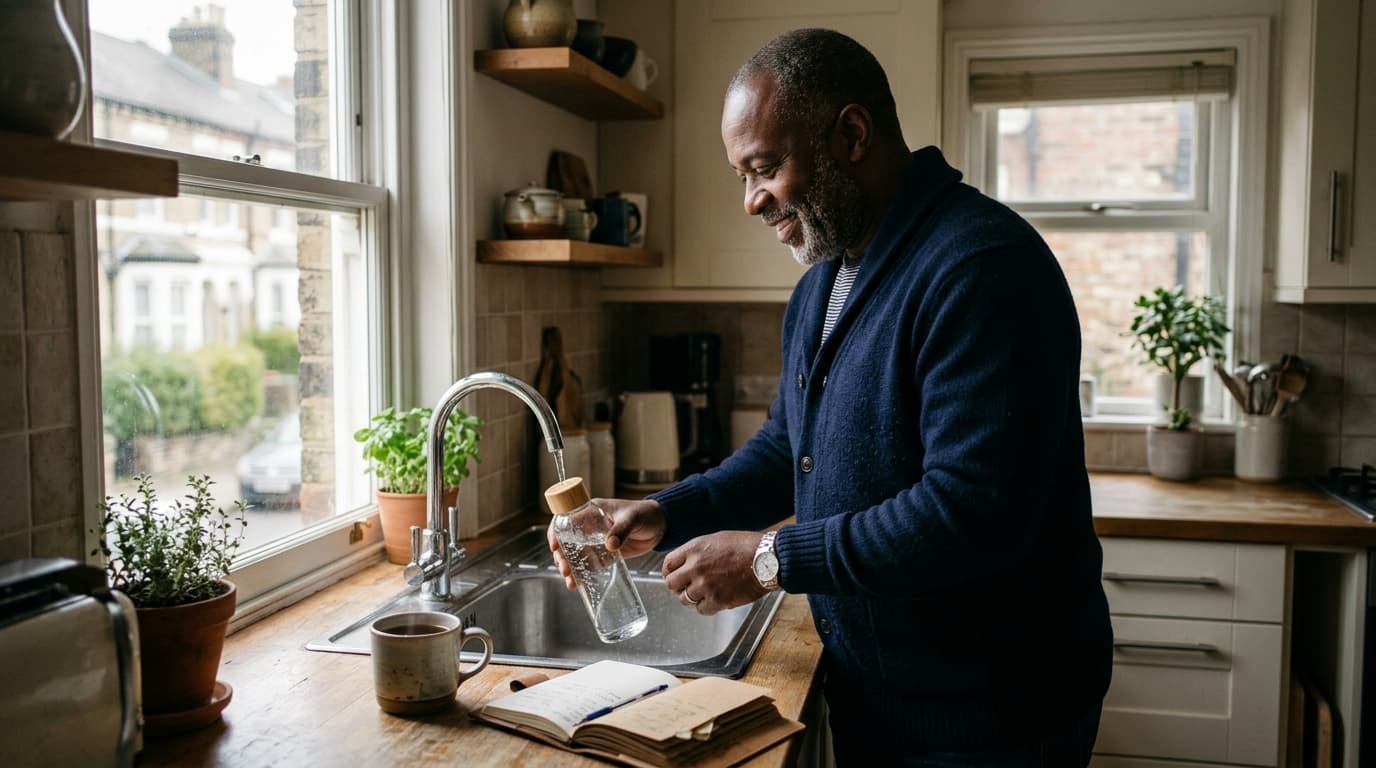
GLP-1 Hydration: Why Drinking Enough Gets Harder
On GLP-1 treatment, fluids can slip two ways: a smaller appetite means less water from food, and nausea, vomiting or diarrhea take fluid out. This piece quotes what the US and EU labels say about dehydration, gives EFSA's general adult reference, and sets out simple if-then routines to keep drinking.
Read more →Ready to start your GLP-1 journey?
Gila helps you build lasting habits, understand your body, and stay on track. Join the pilot for free.
Join the Pilot